

The short answer
ISO 27001 (ISO/IEC 27001:2022) is the international standard for an information security management system (ISMS). It sets requirements for managing risks to the confidentiality, integrity and availability of information: seven mandatory clauses (4 to 10) and 93 Annex A controls chosen through risk assessment. Organisations can be independently certified against it, for three years at a time.
On this page
- What is ISO 27001 in simple terms?
- What does ISO/IEC 27001 mean?
- What is an ISMS?
- What are the main parts of ISO 27001?
- Which version of ISO 27001 is current?
- What is ISO 27001 certification, and how does it work?
- Who needs ISO 27001, and is it mandatory?
- How does ISO 27001 compare with Cyber Essentials, PCI DSS and SOC 2?
- What are the benefits of ISO 27001?
- Why Sovereign Secure
- Next step
ISO 27001 is the international standard for managing information security. Its full name is ISO/IEC 27001:2022, and it sets out the requirements for an information security management system (ISMS): the policies, processes, people and controls an organisation uses to manage risks to its information. Organisations can be independently certified against it, which is why customers and tenders ask for it.
The standard has two parts that matter in practice: seven mandatory clauses (4 to 10) that define how the management system must work, and Annex A, a list of 93 controls you select from according to your risks. It applies to organisations of any size or sector, and covers information in every form, not just IT systems.
What is ISO 27001 in simple terms?
ISO 27001 is a framework for deciding how to protect your information, and for proving that you do. It does not tell you which firewall to buy. Instead it asks you to:
- Decide which parts of the business the ISMS covers (the scope).
- Work out what could go wrong with your information (the risk assessment).
- Choose controls to deal with the risks that matter.
- Run those controls, and make sure people know their part.
- Check that they work, through measurement, internal audit and management review.
- Fix what does not work, and keep improving.
Because it is risk-based, two certified organisations can look very different. A 15-person consultancy and a payment processor meet the same requirements, each in proportion to its own risks.
What does ISO/IEC 27001 mean?
Each part of the name tells you something:
| Part | Meaning |
|---|---|
| ISO | International Organization for Standardization |
| IEC | International Electrotechnical Commission, which publishes the standard jointly with ISO |
| 27001 | Its number in the ISO/IEC 27000 family of information security standards |
| 2022 | The edition year; the current edition was published in October 2022 and amended in 2024 |
The full title ends with the word “Requirements”, and that matters: ISO 27001 is the member of the family you can be certified against. Its companion, ISO 27002, gives detailed guidance on the controls but is not certifiable.
The standard grew out of British Standard BS 7799, first published by BSI in 1995. The first ISO edition followed in 2005, the second in 2013 and the third in 2022.
What is an ISMS?
An ISMS is the way an organisation runs information security as a managed, repeatable process rather than a one-off project. It protects the confidentiality, integrity and availability of information, and it covers people and processes as well as technology. An ISMS is not software you buy: it is your scope, risk assessment, policies, controls, roles, audits and reviews, owned by top management. ISO 27001 defines what an ISMS must include to be certified. Our guide to the information security management system explains how to build, run and audit one.
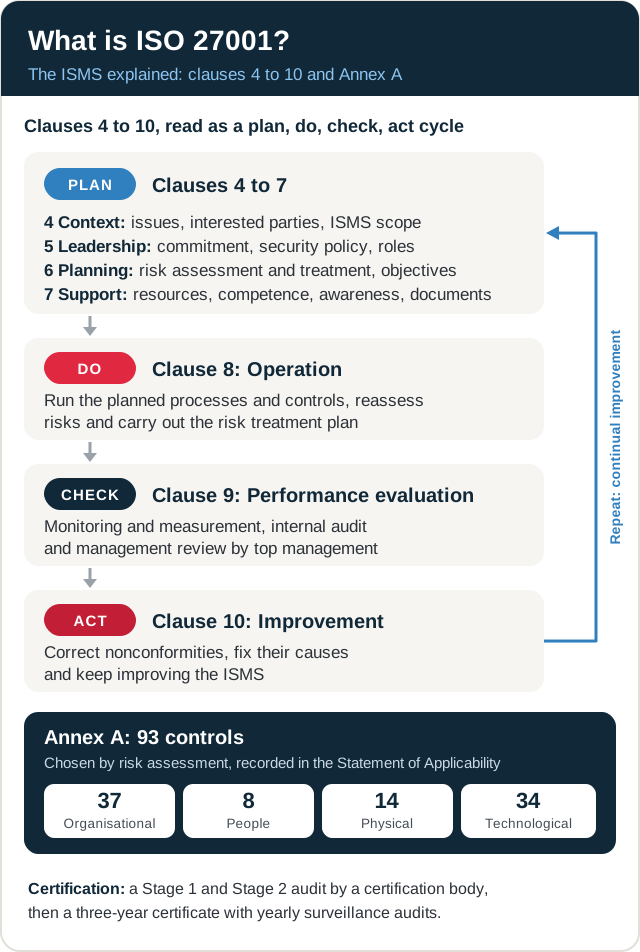
The diagram shows how the pieces fit: clauses 4 to 10 run as a cycle of planning, operating, checking and improving, and the Annex A controls are the safeguards you choose along the way.
What are the main parts of ISO 27001?
Clauses 0 to 3 introduce the standard and its terms. Clauses 4 to 10 are the mandatory requirements, and none of them can be excluded:
| Clause | Title | What it asks for, in one line |
|---|---|---|
| 4 | Context of the organisation | Understand your issues and interested parties, and set the ISMS scope |
| 5 | Leadership | Top management commitment, an information security policy and clear roles |
| 6 | Planning | Risk assessment and treatment, objectives and planned changes |
| 7 | Support | Resources, competence, awareness, communication and documented information |
| 8 | Operation | Run the planned processes, reassess risks and carry out risk treatment |
| 9 | Performance evaluation | Monitoring and measurement, internal audit and management review |
| 10 | Improvement | Continual improvement, and corrective action when things go wrong |
Our guide to ISO 27001 requirements explains each clause and the documents it calls for.
Annex A lists 93 controls in four themes:
| Theme | Controls | Examples |
|---|---|---|
| Organisational | 37 (5.1 to 5.37) | Policies, supplier security, incident management, cloud services |
| People | 8 (6.1 to 6.8) | Screening, awareness training, remote working |
| Physical | 14 (7.1 to 7.14) | Secure areas, equipment, clear desk and clear screen |
| Technological | 34 (8.1 to 8.34) | Access rights, malware protection, vulnerability management, logging, secure coding |
You do not have to implement all 93. You must consider every one, then record which you apply and why in a Statement of Applicability. Our guide to ISO 27001 Annex A controls explains each control in plain English.
Clauses 4 to 10 follow the common structure (Annex SL) that ISO uses for its management system standards, including ISO 9001 and ISO 14001, so an organisation that already holds one of those can run them as an integrated system.
Which version of ISO 27001 is current?
The current version is ISO/IEC 27001:2022, the third edition, published in October 2022 and amended in 2024. The transition from the 2013 edition ended on 31 October 2025, so every valid certificate, and every new certification audit, is now to the 2022 edition.
| Area | What changed from the 2013 edition |
|---|---|
| Annex A | 114 controls in 14 domains (A.5 to A.18) became 93 controls in four themes, 11 of them new |
| Clauses 4 to 10 | A new clause 6.3 on planning changes to the ISMS, plus smaller clarifications |
| Amendment 1 (2024) | Clause 4.1 now asks whether climate change is a relevant issue; a note to 4.2 adds that interested parties may have climate-related requirements |
If your policies or Statement of Applicability still use the old A.5 to A.18 numbering, they need rebuilding on the 2022 control list; our Annex A guide shows the new controls.
What is ISO 27001 certification, and how does it work?
ISO 27001 certification is confirmation, from an independent certification body, that your ISMS meets the standard. Only a certification body can issue the certificate; a consultant prepares you but cannot certify you. Our guide on how to choose an ISO 27001 consultant sets out what to look for and the red flags.
| Step | What happens | Who does it |
|---|---|---|
| 1. Gap analysis | Compare current practice with the standard | You, or a consultant |
| 2. Scope, risks and controls | Set the scope, assess risks, choose controls, produce the Statement of Applicability | You, or a consultant |
| 3. Implement and operate | Put policies and controls in place, train staff and build up records | You |
| 4. Internal audit and management review | Check the whole ISMS before the certification audit | You, or an outsourced internal auditor |
| 5. Stage 1 audit | Review of ISMS design and documentation | Certification body |
| 6. Stage 2 audit | Testing that controls operate in practice, leading to a certification decision | Certification body |
| 7. Surveillance and recertification | Surveillance audits in years two and three; recertification before the three-year certificate expires | Certification body |
For a small or mid-sized organisation, steps 1 to 6 typically take three to nine months. Our guide to ISO 27001 certification cost breaks down consultancy, audit and surveillance fees over the full cycle. Once certified, you show it with your certification body’s mark rather than the ISO logo; our guide to the ISO 27001 logo explains the rules.
Who needs ISO 27001, and is it mandatory?
ISO 27001 is not a legal requirement in the UK. UK GDPR (Article 32) requires appropriate technical and organisational measures to protect personal data, and an ISMS is a recognised way to show you have them, but no law makes certification itself compulsory. EU rules such as DORA and the NIS2 directive likewise require security measures without mandating ISO 27001 certification, although an ISMS covers most of what they ask for.
In practice it becomes mandatory when a customer, tender or partner makes it a condition. That is most common for:
| Organisation type | Why ISO 27001 is asked for |
|---|---|
| SaaS, cloud and hosting providers | Enterprise customers ask for it in supplier due diligence |
| Managed service and IT providers | They hold privileged access to customer systems |
| Payment, fintech and suppliers to banks | Banks’ third-party risk requirements; it pairs with PCI DSS |
| Suppliers to the public sector and healthcare | Tenders often ask for it or score it |
| Outsourcers, data processors and professional services | They handle confidential client data |
| Organisations selling internationally | It is recognised worldwide as evidence of security management |
If no customer has asked for it yet, Cyber Essentials is often a quicker first step, and its evidence carries into ISO 27001 later.
How does ISO 27001 compare with Cyber Essentials, PCI DSS and SOC 2?
They answer different questions, and many organisations hold more than one.
| Aspect | ISO 27001 | Cyber Essentials | PCI DSS v4.0.1 | SOC 2 |
|---|---|---|---|---|
| What it is | Risk-based management system standard | UK government-backed scheme of five technical controls | Payment card industry data security standard | Attestation against the AICPA Trust Services Criteria |
| Scope | The scope you define | Your internet-connected IT, or a defined part of it | Systems that store, process or transmit card data, and connected systems | The systems behind the services in the report |
| Who checks | Independent certification body | IASME-licensed certification body; CE+ adds a technical audit | QSA (Report on Compliance) or self-assessment questionnaire, as card brands and acquirers require | Licensed CPA firm |
| Result | Three-year certificate with annual surveillance | Certificate renewed every 12 months | Annual Attestation of Compliance | Type 1 or Type 2 report |
For side-by-side detail, see Cyber Essentials vs ISO 27001 and PCI DSS vs ISO 27001. If a US customer asks for a SOC 2 report, our guide to SOC 2 compliance explains the examination; if it asks about the NIST Cybersecurity Framework instead, our NIST CSF guide maps it to ISO 27001. The official overview of the scheme is on the NCSC Cyber Essentials site.
What are the benefits of ISO 27001?
The main benefits are commercial and operational: access to contracts that require the certificate, shorter security questionnaires, security spending directed by risk rather than by the latest incident, and a routine of audits and reviews that stops controls drifting. Our article on the benefits of ISO 27001 covers each one and whether certification is worth the cost.
Why Sovereign Secure
- ISO 27001 certified ourselves, so we run the same ISMS routine, internal audits and surveillance audits we prepare clients for.
- Preparation and certification kept separate. We take you from gap analysis to audit-ready through our ISO 27001 consultancy; certification audits are carried out by an independent certification body, our partner MQA International.
- One evidence set for several schemes. As a PCI SSC Qualified Security Assessor (QSA) company and an IASME-licensed Cyber Essentials certification body, we map ISO 27001 to PCI DSS and Cyber Essentials.
- Wider ISO consultancy, including ISO 9001, 14001, 45001, 22301 and ISO 20000-1, for organisations running more than one management system.
- UK company since 2012, headquartered in Accrington, Lancashire (Companies House 08334453).
Next step
If you are deciding whether ISO 27001 is right for you, a gap analysis shows how far you are from certification and what it would take. Use the form below, which is already set to ISO 27001, or call +44 161 523 5276.
Free tools and services
- ISO 27001 checklistClause-by-clause readiness and a Stage 1 and Stage 2 audit checklist, free in Excel.Get the checklist
- Statement of Applicability templateAll 93 Annex A controls in a free spreadsheet, with a worked example.Get the SoA template
- Get an ISO quoteConsultancy from an ISO 27001-certified firm, with audits through our partner certification body, MQA International.Get an ISO quote
Last reviewed October 2026 by the Sovereign Secure assessment team.














